



The early Church leaders at Ephesus (present-day Turkey) wrote that John lived and ministered there. It was in this region that he wrote his gospel, died, and was buried.
Irenaeus, who wrote in the second century, is one of the writers who make repeated reference to John’s ministry in Ephesus. For example, in Against Heresies, he writes, “The Church in Ephesus, founded by Paul, and having John remaining among them permanently until the times of Trajan, is a true witness of the tradition of the apostles” (3.3.4). Irenaeus knew this apostolic tradition firsthand—he had been discipled by the church father Polycarp, who had, in turn, been discipled by the apostle John himself. As both a near contemporary of John and his spiritual “grandson,” Irenaeus provides weighty testimony to John’s Ephesian ministry.
Eusebius of Caesarea, the “Father of Church History,” also bears witness to John’s time in Ephesus. In Book 3 of his Church History, Eusebius compiles and references various 1st and 2nd century sources such as Clement of Alexandria and Polycrates, who was bishop of Ephesus in the late 2nd century. These sources attest that John lived in Ephesus, returned there after his banishment on the island of Patmos, died there, and was buried there.
-- Source: Dallas International University
The blessed John the Evangelist lived in Ephesus until extreme old age. His disciples could barely carry him to church and he could not muster the voice to speak many words. During individual gatherings he usually said nothing but, “Little children, love one another.” The disciples and brothers in attendance, annoyed because they always heard the same words, finally said, “Teacher, why do you always say this?” He replied with a line worthy of John: “Because it is the Lord’s commandment and if it alone is kept, it is sufficient. (6:10)
-- Source: Commentary on Galatians by St. Jerome
Mary’s home has been venerated there for centuries, located about 2 miles outside Ephesus’ ancient ruins.
Ponder
Consider journaling with these reflection questions:
- What emotions might Mary have experienced at this moment?
- How did Mary cooperate with God’s grace during this time in her life?
- What experiences in my life relate to Mary’s?
- How would I describe Mary after reflecting on this moment in her life?
- If I could have a discussion with Mary, what would I ask? What would I say?
Connect
Where Is Mary's House?
-
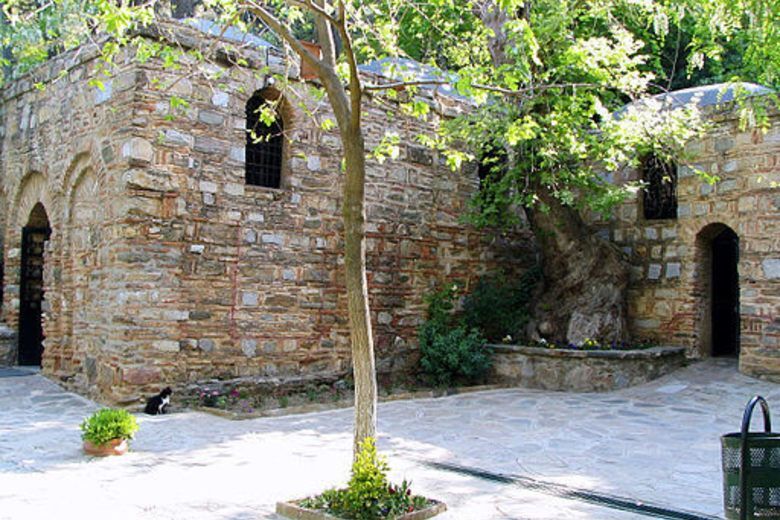 House of Mary
 -
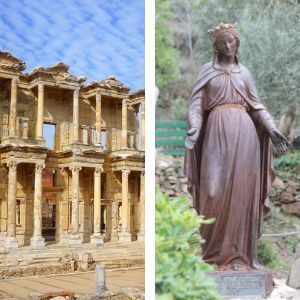 Ephesus ruins & Statue of Mary
Media for You by Pilgrim Center of Hope
Art Featured In this Panel
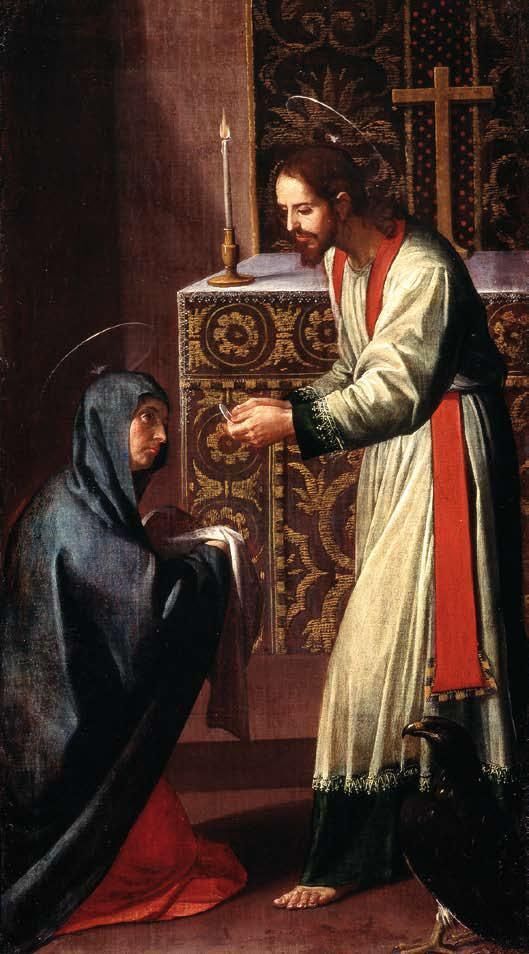
Alonzo Cano's Saint John the Evangelist Giving Communion to the Virgin
This is a faithful photographic reproduction of a two-dimensional, public domain work of art. The work of art itself is in the public domain in its country of origin and other countries and areas where the copyright term is the author's life plus 100 years or fewer.
- Why is Saint John dressed like a priest in this image? John was among the Twelve Apostles who was ordained by Jesus in the Upper Room during the Institution of the Holy Eucharist... He was a priest! This artistic interpretation shows him in garments closer to the ones that priests wear today so that we visually understand his priestly identity. Since we know that the early Christians celebrated the Mass and received Holy Communion, it follows that the Blessed Mother would have received Holy Communion from him while she lived with him.
